High-Quality 5/16 Stainless Steel Tubing Supplies
This introduction highlights high-grade 5/16 stainless steel tubing for U.S. customers. They demand dependable 5 16 stainless tubing for industrial purposes and leisure projects. Well-known names such as CYIWPH, Allstar, and Tynulox actively serve this market with 5/16 stainless steel tubing. Common offerings consist of Type 304 welded coils plus straight 304 tubing lengths.
Most standard options feature a 5/16″ outside diameter with .020 inch wall choices. The materials commonly used are grades 304 and 316. 304 coil prices fluctuate, and 316 frequently has tighter inventory, influencing long-range project scheduling.
Distributors such as Installation Parts Supply focus on industrial-grade and custom tubing solutions. Online retailers and Amazon listings illustrate standard packaging and shipping approaches. Coils are neatly packed for shipping, and straight lengths come with rapid delivery promises. Information such as product weight, parcel dimensions, and ASIN references helps buyers on retail platforms.
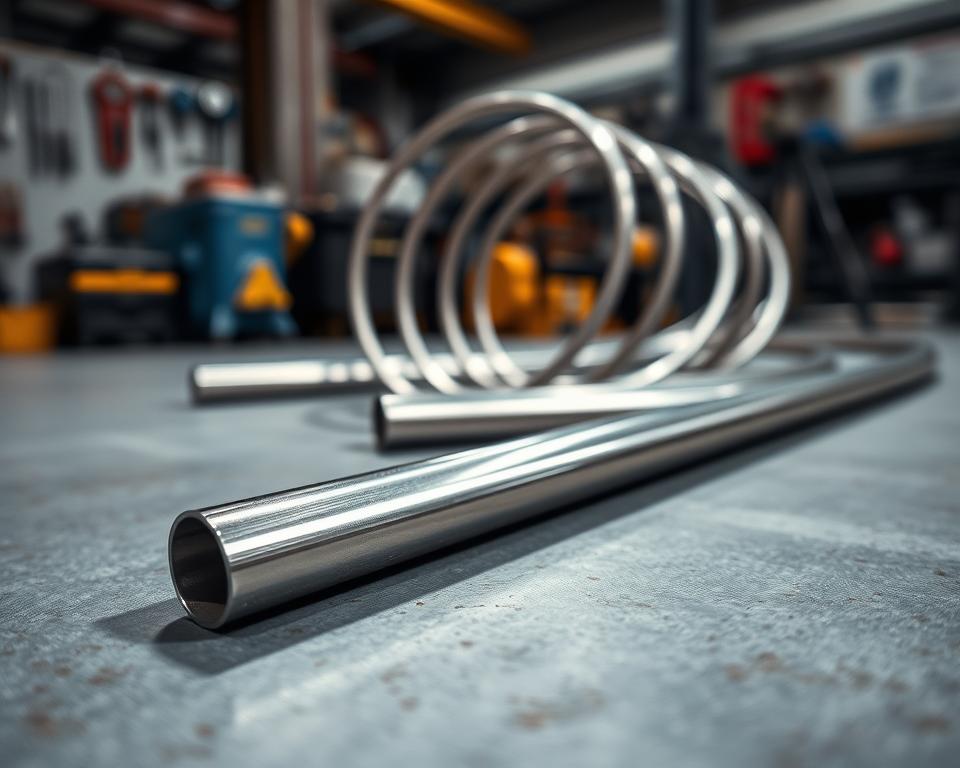
Main Takeaways
- 5/16 Stainless Steel Tubing is available in coiled and straight configurations for flexible application.
- Type 304 is widely stocked; Type 316 can be limited and more costly.
- Premium 5/16 tubing commonly comes with .020 wall options for general industrial systems.
- Installation Parts Supply provides wholesale and custom tubing solutions in stainless metals.
- Always review product listings for parcel size, weight, and customer feedback prior to purchase.
Reasons to Choose Premium 5/16 Stainless Steel Tubing
When selecting materials, stainless steel is a leading choice thanks to its corrosion resistance across many applications. This includes fuel lines, HVAC systems, and marine use. Buyers typically opt for 304 stainless steel for its general utility. In environments where chloride exposure is significant, 316 becomes the preferred option for its stronger performance.
Stainless steel tubing delivers obvious material benefits. 316 stainless, for instance, is noted for its strong resistance to pitting and crevice corrosion, especially where chlorides are present. Meanwhile, 304 stainless provides excellent weldability and machinability. This flexibility enables one length of stainless steel tubing to handle different tasks in a project, helping avoid premature replacement.
When it comes to industrial tubing, advantages such as dimensional stability, uniform wall thickness, and resistance to surface wear become critical. High-grade 5/16 stainless steel tubing helps guarantee tight-fitting connections. It also minimizes the potential for leaks and maintains optimal flow in systems.
Upgrading to superior tubing often reduces maintenance demands and downtime over the system lifespan. While 316 stainless may have a higher starting price and sometimes tighter availability, its durability and lower replacement frequency can provide better project economics. Opting for corrosion-resistant tubing from the start can also decrease overall costs for long-term installations.
| Factor | 304 Stainless | 316 Stainless |
|---|---|---|
| Typical use cases | Fuel systems, HVAC loops, general instrumentation lines | Marine circuits, heavy chloride exposure, chemically aggressive settings |
| Corrosion resistance | Good for most environments | Superior, especially vs. chloride attack |
| Availability for 5/16 size | Common in coils and straight tubes | Sometimes limited; can be sold out for specific coils |
| Cost impact | More economical initial cost | Higher upfront cost but lower replacement needs |
| Best choice when | Budget-sensitive projects with moderate exposure | Projects demanding top-tier corrosion resistance |
Specifications and Common Configurations for 5/16 Stainless Steel Tubing
5/16 stainless steel tubing is compact but highly versatile, well-suited to fluid transfer and light structural duties. Its outside diameter of 0.3125 inch works well in confined routing spaces. Before purchasing, ensure the tubing’s specifications meet your system’s pressure, bend radius, and application requirements.
The strength and flexibility of this tubing depend on the chosen dimensions and wall thickness. You can find wall thicknesses like 0.020 in, 0.028 in, and 0.049 in from suppliers. For Type 304 and Type 316 stainless steel, most coil products are 5/16 OD with a .020 wall. Straight lengths are available from 12 to 96 inches.
Coiled tubing is excellent for snaking through tight routes and bends. In contrast, straight lengths are ideal for straight runs and simple structural lines. Coil lengths typically extend to 25 ft and 20 ft, chosen often for easy installation and fewer connections.
Different material grades are chosen based on corrosion behavior and forming needs. Type 304 stainless steel is common for its solid corrosion resistance, good weldability, and relatively low cost. Type 316 offers better protection against chloride and harsh chemicals, suited to marine installations and any system with notable salt or chloride presence.
In supplier catalogs, you’ll find options for both welded and seamless tubing. Online markets frequently carry welded 304 coils. For higher pressure or aesthetic demands, you can purchase seamless round tubing and welded straight lengths. Make your tubing choice by evaluating pressure limits, finish preferences, and forming plans.
Fabricators often point out the slight differences between Type 316 and 304’s machinability. When forming small-diameter tubing, consider how wall thickness affects control over springback and wrinkles. Compression fittings and AN/flare adapters are widely used for connecting 5/16 tubing in various systems.
The versatility of this tubing is evident in its numerous applications: spanning automotive fuel lines, HVAC installations, and marine loops. For food and pharmaceutical projects, choose tubing that complies with relevant sanitary and regulatory requirements.
| Attribute | Typical Options | Notes |
|---|---|---|
| Outside diameter | 0.3125 in (5/16″) | Common nominal size for compact routing |
| Wall thickness | 0.020, 0.028, 0.049 in | Thinner walls bend easier; thicker walls raise pressure rating |
| Material grades | Type 304, Type 316 | 304 for general use; 316 for marine and chloride exposure |
| Form factor | Coils (20–25 ft), Straight (12–96 in) | Coils help cut joint count; straight runs work best for rigid layouts |
| Manufacturing | Welded vs seamless tubing | Welded is typical for coils; seamless is favored for high pressure and clean aesthetic |
| Common fittings | Compression, flare, AN adapters | Widely available in hardware and specialty suppliers |
Where to Buy High-Quality 5/16 Tubing and Coil Options
Sourcing trustworthy 5/16 stainless steel tubing suppliers simplifies projects and ensures accurate dimensions plus traceability. Here are tips for bulk buying, identifying retail coil choices, and using a checklist to validate stainless tubing.
Use wholesale distributor channels when you have ongoing supply requirements or need specialized custom runs. Installation Parts Supply, located in the U.S., is a well-known distributor that provides a wide range of industrial tubing. They handle orders for cut-to-length pieces, coils, and straight tube segments. Purchasing from a wholesaler usually means improved volume pricing, clear material traceability, and better technical support for specification and customization questions.
Retail coil options suit smaller tasks or when you need items quickly. An example is the CYIWPH 5/16″ x 25 ft 304 welded coil available on Amazon, which has received strong customer feedback. Catalogs detail prices for 5/16″ 304 coils starting at $34.99 to $123.99, and 316 coils vary between $46.99 to $149.99, depending on availability. The availability of Type 316 can change frequently, so checking inventory often is crucial.
Employ the following checklist to prevent making expensive mistakes when purchasing stainless steel tubing:
- Confirm outside diameter (0.3125″) and selected wall thickness (.020, .028, .049).
- Verify welded versus seamless construction for your application.
- Decide between coil length and straight-cut lengths based on handling and installation needs.
- Request mill test reports or material certificates (MTRs) for traceability and grade verification.
- Check OD and wall tolerances, finish, and compatible fittings availability.
- Review shipping and pickup policies; many suppliers ship next business day for orders placed before 3pm.
- Compare pricing by coil length and wall thickness to find the best cost-per-foot.
Suppliers like Metals ‘R’ Us often provide MTRs upon request. If your project needs chloride resistance, ensure your supplier has Type 316 in stock. When researching where to buy 5/16 stainless steel tubing, weigh wholesale distributor advantages against retail coil flexibility to satisfy both budget and schedule.
To avoid regret, take time to scan customer ratings and confirm product dimensions before placing an order. Installation Parts Supply and other notable vendors usually provide specification guidance so you can match fittings and components to your tubing correctly.
Corrosion Resistant Tubing and Material Selection Guidance
To choose proper tubing, you must first understand your application and environmental conditions. Corrosion-resistant tubing helps maintain system integrity in wet, salty, or chemically aggressive settings. For small-scale projects and specific lines, 5/16 stainless steel tubing is often preferred thanks to its strength and compact size. An informed material choice helps keep downtime and lifecycle costs lower.
Choosing between common stainless grades
Grade 304 is widely favored in industrial and internal systems for its good corrosion resistance and lower price. In scenarios involving chloride, seawater, or harsh chemicals, grade 316 is the better choice, because its molybdenum addition helps fight pitting and crevice corrosion. Budget considerations and availability are important — 316 typically costs more and may be harder to find. It’s crucial to compare 304 vs 316 stainless steel carefully when choosing fittings, especially for critical 5/16 stainless steel tubing runs.
Environmental factors that shorten tubing life
Salinity, chlorides, and exposure to chemicals can trigger localized corrosion problems. Corrosion accelerates under high temperatures. Mechanical abrasion and contact with different metals can induce wear and galvanic corrosion. For environments prone to chloride-induced deterioration, 316 is recommended. Effective selection of tubing materials considers these elements prior to installation.
Maintenance and preventative measures
Maintenance practices, including regular inspections and cleanings, help identify early stages of corrosion. To minimize damage risks, select compatible fittings and follow proper installation techniques. It’s essential to avoid direct contact between stainless tubing and incompatible metals. This can involve using dielectric fittings to avoid galvanic corrosion. In food or pharmaceutical applications, maintain cleanliness and verify compatibility by requesting MTRs and reviewing surface finish before buying.
Best practices table for material and upkeep
| Issue | 304 Recommendation | 316 Recommendation | Maintenance Tip |
|---|---|---|---|
| General indoor corrosion | Good performance and cost-effective | Over-specified; use only if needed | Seasonal visual inspection and wipe-down |
| Marine or chloride exposure | At risk of pitting and crevice corrosion | Preferred for pitting resistance | Rinse with fresh water and inspect crevices |
| Chemical contact | Acceptable for mild chemicals | Better for chloride and aggressive agents | Verify chemical compatibility and MTRs |
| Mechanical abrasion or bending | Good ductility for bends | Similar formability; choose based on environment | Use correct bend radii and avoid kinks |
| Sanitary or food/pharma | Often acceptable with polished finish | Preferred for higher hygiene demands | Confirm surface finish and MTRs before use |
Final selection checklist
- Match the grade to exposure: test 304 vs 316 stainless steel for your site.
- Confirm availability for 5/16 stainless steel tubing when ordering long runs.
- Plan maintenance stainless tubing routines: cleaning, inspection, and fitting checks.
- Request mill test reports and verify surface finish for sanitary or high-risk uses.
Custom Tubing Solutions, Fabrication Services, and Compatibility
Custom tubing solutions are especially valuable on projects that require precise dimensions and material traceability. Suppliers offer a wide variety of services for 5/16 stainless steel tubing. This includes cut-to-length sections, mandrel bends, and end-forming services. These services cut down on on-site labor and speed installation of fuel, instrumentation, and hydraulic lines.
Cut-to-length tubing is often the fastest method for sourcing ready-to-install parts. Common formats include straight 12″ segments and coils. Fabricators like Metals ‘R’ Us, alongside wholesale distributors, provide cutting, flaring, and coiling services. It is crucial to select shops that record exact OD and wall thickness tolerances in their documentation.
Fittings compatibility plays a critical role in achieving long-term reliability. For 5/16 stainless steel tubing, the primary choices are compression and flare fittings. It’s essential to pair stainless fittings with stainless tubing to prevent galvanic corrosion. Several marketplaces feature a variety of adapters, including AN-to-flare and flare-to-compression, designed for fuel and instrumentation line service.
When ordering custom tubing, one must be mindful of minimum order quantities and lead times. Companies like Installation Parts Supply publish cutoff times, often around 3 pm, that allow next-day pickup on standard orders. Orders requiring custom specifications or certifications might face longer processing times and likely have minimum order commitments. It is wise to confirm lead times, shipment methods, and documentation requirements before completing your order.
Quality assurance and certification are paramount for regulated projects. A mill test report (MTR) verifies tubing grade and composition for each production batch. Documented inspections should indicate whether OD and wall thickness tolerances are being met. Reliable suppliers provide MTRs when asked and maintain traceability for aerospace, medical, and petrochemical work.
Summary
Stainless steel tubing measuring 5/16 inches (0.3125″ OD) combines durability and resistance to corrosion, serving numerous projects efficiently. You can find common wall thicknesses like .020, .028, and .049 in both 304 and 316 stainless steel types. Project needs determine whether you choose coils or straight sticks, as well as welded or seamless designs.
Engaging a wholesale distributor, such as Installation Parts Supply, provides advantages including access to premium tubing, complete material traceability, and mill test reports. They also supply custom tubing services including cut-to-length and specialized coil setups. It’s crucial to confirm OD, wall tolerances, chosen grade, coil or straight format, and shipping terms ahead of purchase.
To maximize long-term value and keep maintenance under control, opt for 304 grade for typical industrial use. However, for areas with high chloride presence or marine settings, 316 grade is the better choice thanks to its higher corrosion resistance. By using proper bending techniques, pairing compatible fittings, and performing regular wear inspections, you can greatly extend tubing life and reduce costs over time.
For buyers in the U.S., it’s a good idea to evaluate Installation Parts Supply for wholesale pricing and custom tubing choices. Make sure the 0.3125″ OD, wall thickness, and chosen grade align with your requirements. Request mill test reports if needed, and decide whether coils or straight lengths, along with suitable fittings, fit your project’s requirements.